Wednesday, January 28, 2015

In California Prisons, Hundreds Have Been Removed from Solitary Confinement———and Thousands Remain


It has been over three years since the first statewide hunger strike in protest of the California prison systems’ use of solitary confinement. The hunger strike, the first of many to follow, was launched by individuals housed in the state’s Security Housing Units (SHUs). The hunger strikes prompted state Legislative hearings, international scrutiny, and some reforms.
The SHU, first established in 1989 at Pelican Bay State Prison, was designed to house the “worst-of-the-worst” in close, secure, isolated confinement. Keeping individuals in small, windowless cells for 22 1/2 to 24 hours a day eventually proved to be a convenient solution to deal with individuals exhibiting behavioral or mental health problems and real or suspected gang affiliation as well.
The SHU, once limited to Pelican Bay, has been expanded to a total of four male facilities and one female facility. Despite this expansion, California doesn’t have enough room in the SHUs for all the individuals prison officials would like to place in them, necessitating their placement in Administrative Segregation Units (ASUs), which are dispersed throughout each prison.
By 2011, there were thousands of individuals in the SHU, including over 1,100 in the Pelican Bay SHU alone. Of them, approximately half had been in the SHU for over a decade and 78 had been in the SHU for at least 20 years.
In June 2011, individuals in the Pelican Bay SHU coordinated a hunger strike in protest of long-term isolation. The hunger strike lasted three weeks, notably bringing together people of all racial groups. There would be an additional hunger strike that year, followed by a third, 60-day-long hunger strike in July 2013.
Partly in response to the hunger strikes, the California Department of Corrections and Rehabilitation (CDCR) proposed and implemented an array of reforms purportedly aimed at tightening the standards for SHU placement and potentially reducing the number of individuals held in highly restrictive custody.
Beginning in October 2012, the CDCR has changed the criteria used to place individuals in the SHU, created a “Step Down Program” for individuals to transition out of the SHU, and began a process of case-by-case reviews of all individuals held in the SHU and ASU to determined the appropriateness of their placement.
The reviews are ongoing, but the data collected so far is quite revealing.
According to data obtained from CDCR, 725 SHU case reviews have been conducted, with about 69%  those cases leading to release to the final step in the Step Down Program and/or a General Population setting. A further 63% of ASU case reviews have led to a return to the general population.
In other words, in most cases, it appears that under slightly stricter standards, CDCR could not justify keeping individuals in highly restrictive, isolating conditions.
With these reviews being conducted for over two years now, and the overall decline of the prison population, one would expect that the number of people in restrictive housing would be on the decline.
Officially, CDCR does not believe it holds individuals in solitary confinement. Thus, a true count of the total number of individuals in such conditions is difficult to determine. The purpose of this research is to use CDCR data to provide a means of determining how many individuals might be in solitary confinement.
The CDCR releases pertinent data through COMPSTAT (COMPuter STATistics or COMParative STATistics). CDCR  keeps track of the following data: the number of individuals in single-celled housing, the number of individuals in the SHU and ASU, and the number of individuals in the SHU and ASU in single-celled housing. This data is the closest one can get to determining the number of individuals in solitary confinement.
Total Single Cell Population
Presented first is a comparison of the reported single-cell population per institution in October 2012 and October 2014.
Single Cell
Number of individuals reported on Single-Cell status in October 2012 and October 2014
In October 2012, there was a prison population of 124,718. At that time, were 6,281 individuals who were single-celled, or 5.03% of the prison population. In October 2014, there was a prison population of 120,705.  There were 5,546 individuals who were single-celled, or 4.59% of the prison population.
In 2012, 4,572 of those single-celled were designated with an S-Suffix, or 72% of the single-celled population. In 2014, 4,975 of those single-celled were designated with an S-Suffix, or 89% of the single-celled population. Individuals designated an S-Suffix are generally placed on single-celled status for longer periods of time.
SHU Population
The SHU is used to house people deemed security threats over the long-term. Given the outcomes of the case-by-case reviews, a reduction in the SHU population has occurred since 2012.
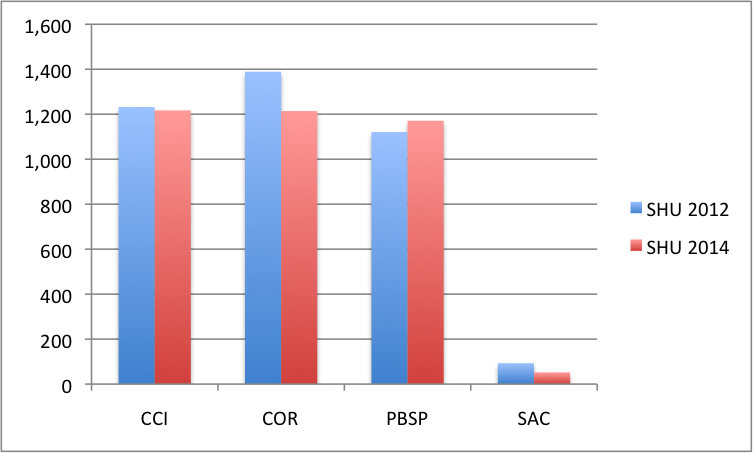
SHU TOTAL
SHU Populations In October 2012 and October 2014 reported through COMPSTAT.

In October 2012, the total SHU population stood at 3,923. In October 2014, the total SHU population was 3,732.
As can be seen in the above chart, there were reductions in the SHU population in all four male institutions, with the exception of the Pelican Bay SHU. In October 2012, there were 1,121 held in the Pelican Bay SHU; two years later the figure was 1,171.
While there has been an increase in the number of individuals in the Pelican Bay SHU, there has also been a decline in the number of individuals in the Pelican Bay SHU on single-cell status. In 2012, 83% of those in the SHU were on single-cell status. In 2014, about 75% of those in the Pelican Bay SHU were on single-cell status.
At the California Institution for Women, there have been slight reductions in use of the SHU. In October 2012, there were 88 women in the SHU, with none on single-cell status. In October 2014, there were 78 women in the SHU, with four on single-cell status.
Among the SHU population system-wide, there have been reductions in the number and percentage of individuals on single-cell status. In 2012, there were 1,849 individuals in the SHU on single-cell status, approximately 47.1% of the SHU population. In 2014, there were 1,721 individuals in the SHU on single-cell status, or about 46.1% of the SHU population.
It is important to note that those removed from single-cell status might well still be locked down 22 to 24 hours a day–but in cells with one or more other people.
ASU Population
Aside from the SHU, the ASU also serves to isolate individuals in the California prison system, though generally for shorter periods of time than the SHU. There is no typical term in the ASU, which can range from hours to years. Unlike the SHU, the ASU is not designed to be long-term housing.
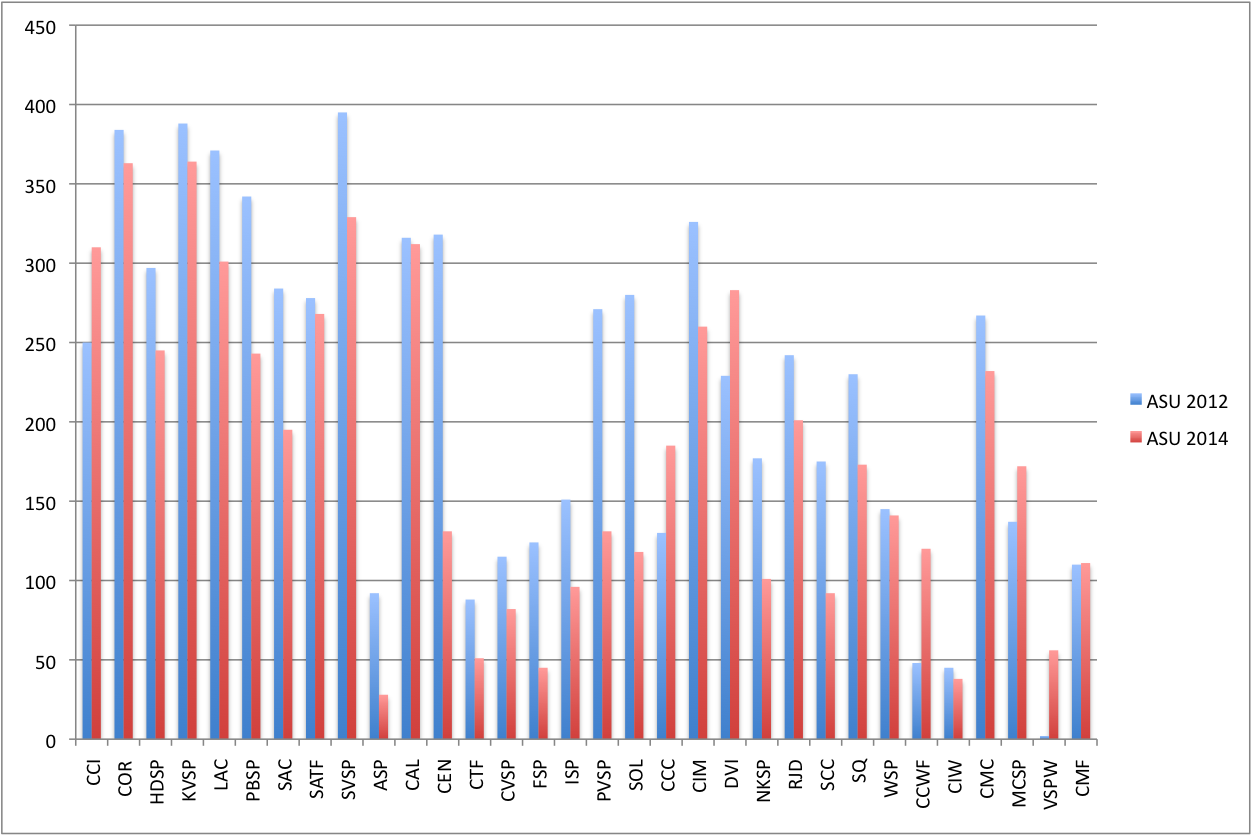
ASU Total
ASU Population as reported through COMPSTAT in October 2012 and October 2014.

Overall, the total number of individuals in the ASU declined significantly between 2012 and 2014.
In October 2012, there were 7,007 individuals (5.61% of the prison population) in ASUs:
  • Of them, there were 1,547 on single-cell status (22%)
  • Salinas Valley State Prison had the largest ASU population (395) and the largest population of ASU prisoners on single-cell status (202)
  • Valley State Prison reported only having two people in the ASU
  • Some prisons reported having no single-celled ASU prisoners: Chuckawalla Valley State Prison, California Correctional Center, San Quentin State Prison, and Valley State Prison for Women
In October 2014, there were 5,777 individuals (4.78% of prison population) in ASUs:
  • Of them, there were 1,289 on single-cell status (22.3%)
  • Kern Valley State Prison had the largest ASU population (364)
  • Salinas Valley State Prison had the largest single-cell ASU population (165)
  • Central California Women’s Facility, California Correctional Center and Correctional Training Facility reported only having two people in the ASU on Single-Cell Status
  • Some prisons reported having no single-celled ASU prisoners: Avenal State Prison, Chuckwalla Valley State Prison, Sierra Conservation Center, and California Institution for Women
ASU S
ASU single-cell population reported through COMPSTAT for October 2012 and October 2014.
The fluctuations in single-cell status across institutions are as of yet unexplained.
Unlike what is available for the SHU, CDCR makes available through COMPSTAT the average terms in the ASU per institution. ASUs are not designed for long-term housing and do not typically come with any significant form of programming. While in theory individuals shouldn’t spend very much time the ASU, COMPSTAT data consistently shows long-terms in the ASU.
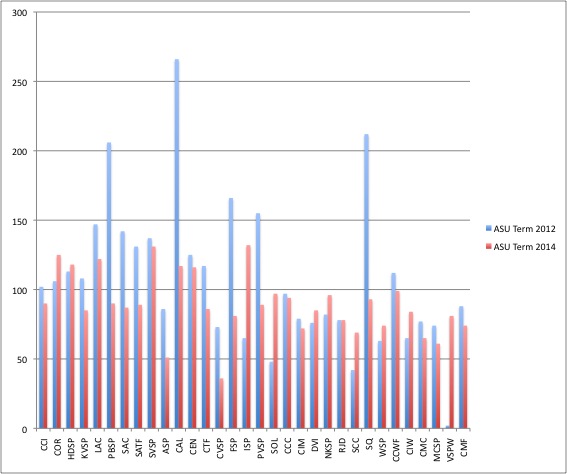
ASU Term
Breakdown of the average lengths of stay in ASUs prisons reported in October 2012 and October 2014.
As seen in the above chart, lengths of stay in the ASU vary across prisons and time.
In October  2012, the average term in the ASU was 107.5 days. Two years later, the average ASU term was 89.6 days, a significant decline.
In 2012, among male facilities, Sierra Conservation Center had the lowest average length of stay in the ASU, with an average of 42 days. Calipatria State Prison had the longest, with an average ASU stay of 266 days. In 2014, Chuckawalla Valley had the briefest length of stay of stay in the ASU, with terms of 36 days. Ironwood State Prison had the longest average stay in the ASU, at 132 days.
Conclusions
It appears that the total use of single-cell housing is on the decline. Further, total use of SHU and ASUs in both raw numbers and as a percentage of the prison population have declined. In the SHU, there has been a slight decline in the use of single-cell housing, though a slight increase in the SHU population at Pelican Bay State Prison. In the ASU, the percentage of individuals in the ASU on single-cell status has slightly increased, though there have been significant declines in terms of stay in the ASU.
There are a few potential explanations for the decline in single-cell placement and the use of segregation units. First, the case-by-case SHU and ASU reviews that have been occurring have undoubtedly contributed to the decline of segregation populations. As a result of those reviews, hundreds of individuals have been transferred out of the SHU and ASU and placed in general population. Second, there ought to have been reductions in the total single-cell population in part due to court-ordered reforms pertaining to the segregating of individuals receiving mental health treatment. Thirdly, it is possible that some individuals in segregation units have benefited in recent years from prison population reductions.
Thus far, for advocates of reducing the use of solitary confinement, there is cause for cautious optimism within the data. At the same time, there is much more that can be done.

UN Committee on Torture Says U.S. Must Reform Its Use of Solitary Confinement


supermax2On November 28, the United Nations Committee Against Torture released a 15 page report reviewing the United States’ compliance with the UN Convention Against Torture and Other Cruel, Inhuman or Degrading Treatment or Punishment (CAT). The report cites the excessive use of solitary confinement in U.S. prisons and jails as a violation of CAT, and recommends a set of dramatic reforms.
The report is a follow up to the Committee’s meeting with United States government officials on November 12 and 13 in Geneva. As a state party to CAT, the United States is expected to submit a “Periodic Report” detailing its adherence to the Convention, as well as respond to questions, observations, and recommendations for change issued by the Committee. Over the two days, the United States delegation presented its latest periodic report for a ten-member Committee to review, after almost an 8 year gap since the last such review.
The U.S. government’s periodic report discusses some 55 separate issues of concern to the Committee Against Torture ranging from the treatment of immigrants in detention, the death penalty, police brutality, and sexual abuse of people in prison to the rendition and secret detention of terror suspects and their continued presence at Guantanamo Bay. In all cases, the United States insists that it is in compliance with CAT, even as several human rights and civil liberties organizations submitted shadow reports telling otherwise. (Access them here: American Civil Liberties UnionCenter for Constitutional Rights, Legal Services for Prisoners with Children and California Prison FocusAmerican Friends Service Committee; NY CAIC; the Correctional Association of NYNRCATT’ruahVictorious Black Women, and the Midwest Coalition for Human Rights.)
The U.S. periodic report also attempts to dismiss the Committee on Torture’s concerns on solitary confinement–which the UN Special Rapporteur on Torture defines as “physical and social isolation of individuals who are confined to their cells for 22 to 24 hours a day,” and to which some 80,000 people are being subjected to every day in the United States. As per the U.S. report, there is “no systemic use of solitary confinement in the United States.”
However, in Geneva, members of the Committee Against Torture raised multiple questions and concerns about solitary confinement in U.S. prisons and jails. Committee Vice-Chairperson George Tugushi questioned the American delegation about measures taken to limit the use of solitary confinement, especially on children and other vulnerable individuals. Another Committee member, Alessio Bruni, asked about prolonged solitary confinement such as is being used in Louisiana, where individuals have been isolated for 30 years, and noted that such treatment caused “anxiety, depression and hallucinations until their personality is complete destroyed.”
Both in its periodic report and during the hearings, the United States government sought to assure the Committee on Torture that sufficient restrictions on the imposition of solitary confinement are already in place. At the hearings, David Bitkower, the Deputy Assistant Attorney General at the Department of Justice maintained that “U.S. courts have interpreted the Eighth and Fourteenth Amendments of the U.S. Constitution as prohibiting the use of solitary confinement under certain circumstances.” The U.S. periodic report further claims that The Americans with Disabilities Act of 1990 (ADA) and the Rehabilitation Act of 1973 (Rehabilitation Act) limit the use of solitary confinement against persons with mental illnesses and other disabilities, while the PREA [Prison Rape Elimination Act] offers protection from the same for children.
But in its “Concluding observations” released last week, the UN Committee reaffirms that “it remains concerned about reports of extensive use of solitary confinement and other forms of isolation in US prisons, jails and other detention centres for purpose of punishment, discipline and protection, as well as for health-related reasons” even as the United States denies any “systemic use.” In the report, the Committee once again raises concerns on the use of solitary confinement for indefinite periods of time, its use against children and persons with mental disabilities, and the general lack of pertinent statistical data. The report also states that the isolation of prisoners for 22 – 23 hours a day as used in super-maximum security prisons is “unacceptable.”
The Committee lays forth several recommendations for the United States to ensure its policies on solitary confinement are in better compliance with CAT. It asks the U.S. government to restrict the use of solitary confinement “as a measure of last resort, for as short time as possible, under strict supervision and with the possibility of judicial review.” Further it reasserts the need to ban the imposition of solitary confinement on “juveniles, persons with intellectual or psychosocial disabilities, pregnant women, women with infants and breastfeeding mothers in prison.” It also stresses that “regimes of solitary confinement such as those in super-maximum security detention facilities” need to be banned. Finally, the Committee once again brings attention to the lack of detailed information on the use of solitary confinement. It asks the United States to “compile and regularly publish comprehensive disaggregated data on the use of solitary confinement, including related suicide attempts and self-harm.”
Asked how he believes the U.S. government might respond to these recommendations, David Fathi, Director of the ACLU’s National Prison Project said: “We shouldn’t hope for dramatic change.  Even if the federal government were highly motivated, it has limited authority to affect conditions in state and local facilities, where ninety percent of prisoners are held.” However, he hopes that the Committee’s report “may give an added push to states and localities that are already considering solitary reform.”

Wednesday, September 25, 2013

Good Morning....


I know I have neglected you for to long, again.  Will you welcome me back with open arms?  You won't?  That's to bad.  We could have had a future together.  You with your white space that needed to flourish in the journalistic world and me with the letters of the alphabet to to convey my message to the world. Please, give me one more chance?  Oh, thank you.

Wednesday, January 23, 2013

Do Your Own Time


Do Your Own Time
“Man, I saw the funniest thing this morning.” The young prisoner announced. “There were men down in the church saying “Praise the Lord” and “Alleluia” and raising their hands.”  I gave the prisoner the “Prisoners Handbook” response, “Do your own time.”  “More power to em.”  The courts had sent me to the U. S. Medical Center for psychiatric evaluation for 90 days.  I had changed my guilty plea to “not guilty by reason of insanity.” Merely a manipulative move on my part, to avoid being sentenced on my birthday.  Still I wondered about my own inability to stay out of prison.  “Why me?” You might say.
                                                                           ~~~~~~~~~~~~~ 
I sat looking out the window of my cell at the St. Louis city jail.  The moment was innocuous to any particular thing that was going on.  There, leaving the adjoining court house was a man wearing the garb of a janitor.  In his hand was a black lunch box.  “Why couldn’t I be satisfied with that?” I wondered.  “A job, a wife and family”… I stopped my thoughts and crossed them off as wishful thinking. Prison life was all I knew and had resigned myself to the fact that I would live the rest of my life in prison and even die there.   
                                                                           ~~~~~~~~~~~~~~~
I hadn’t planned to go to church the following Sunday, it just happened.  I was coming down the stairs from the chow hall, and there, going into the church, was a group of volunteers.  One of the volunteers I recognized was Mary Lipscomb. She was a teacher in the Learning Center where I spent a fair amount of my time.  I still hadn’t reconciled Springfield (U. S. Medical Center for Federal Prisoners) to the many prisons I had been to.  Stateville, Menard, Marion; These were no walk in the park type prisons.  They were mean and mean things happened in them.  Springfield had women running all over the place, it seemed. In the school, the hospital, the kitchen, even the women who worked in the administration offices were often seen traveling the halls. 
The early 70’s was a time of upheaval, not only in America, but in its prisons, as well.  Several large scale riots had happened all across the country.  One of the appeasements that came about was the authorization of ethnic culture clubs.  Afro-American, La Causa Latina, Italian-American, American Indian, even Irish American, existed.  For a club to be approved in Springfield, you had to have an inside sponsor and an outside sponsor. These were people who would oversee the activities.  And yes, more volunteers from the community came to the weekly meetings.  It was going to take some getting use to.
The Medical Center was a three ring circus, I liked to say: “Medical” for prisoners who were patients; “Psychiatric” for those who were deemed necessary for psychiatric care and “Maintenance” prisoners who were there for the upkeep of the institution.  For the most part, prisoners who were there for the maintenance of the institution were kept in the camp quarters.  Supposedly, they didn’t have a lot of time and were non-violent.  Yeah, right.
I followed the small crowd going into the chapel.  “God’s House of Hope” the sign said.  I made my way to the back of the church and sat down.  Springfield, Mo. is home to the headquarters of the Assemblies of God denomination.  Most of the volunteers were from Assembly of God churches, though not Mary. The songs were familiar from my childhood days at Glenwood School for Boys where church was mandatory.  “The Old Rugged Cross,” “Amazing Grace,” “In the Garden” was some of the popular hymns that were sung.  I sat there silently.
I had a militant attitude toward most everything back then. I was quick to hate and reviled do-gooders. I had come to a position that justified my anger toward religion.  “We don’t choose to be born. We don’t choose who are parents will be. We don’t choose whether we’re born on the gold-coast or in the ghetto, and we don’t choose whether we will be loved or rejected.” I came up on the short end almost on each count.  So about the 4th week of going to church the Bible instructor after the service was talking about free will.  I did not have a choice, but rather I was a product of my environment “Now, after spending 26 years, half of them spent in prison, you tell me I have a free will.”  I could feel the unease that permeated this now silent church. The instructor answered that he would talk to me after the class was over. But I had no intention of waiting to hear what he had to say.
As I exited the pew I had been sitting in, an elderly lady blocked my escape.  Though I stand only 5’ 11” at best, I towered over the slightly built, white haired woman before me.  She looked like everyone’s grandma, a sweet smile that could melt the heart of even the angriest of persons.  “Sonny,” she said, “you may not understand this, but God has a plan for your life.”  If God had a plan for my life it could only include more of the same which I already had, punishment. I knew her name to be ‘Mom Carter,” Her son-in-law and daughter, Lloyd and Nita Colbaugh were also volunteers at the prison. I hurried out the door vowing never to return. 
The next morning I entered the Learning Center and handed my pass to the young lady at the desk, Mary Lipscomb.  “It was good to see you in church yesterday.” She said.  “Yeah, I go every Sunday, but it’s not doing me much good.” I snarled.  “Do you believe in God?” Mary asked.  “I believe there’s somebody up there that’s running all this.” I answered.  “Have you ever prayed?” She asked.  “Sure” I responded, “I asked him once to get me out of boy’s school? He said no.”  I felt a bit awkward that I had continued the conversation and sought to end it.  “Look? God and I have a perfect understanding, I’ve never done anything for him, and he has never done anything for me. We’re even.” I flippantly concluded and spun on my heels and went to my seat. 
I did not anticipate the turmoil I had set in motion as I tried to sleep that night.  Sure, I had been rude to her in my spinning away and my surly attitude. But so what, I didn’t care about anyone, least of all someone who had no idea of what prison is about.  The grapevine had Mary pegged as being someone who came from an affluent family in town who probably had everything in life handed to her on a silver platter.  Why should I care?  But I did, and that bothered me even more.  I would go to the Learning Center and apologize. Eventually, sleep found me and I retired for the night.
The next morning I greeted Mary by saying, “Look” I didn’t mean to be rude yesterday. Most of the men have nothing but good things to say about you, so I apologize.”  And then I walked away.  Well, I tried to.  Mary stopped me with, “You know, God can change your life.”  “God didn’t want to have anything to do with me.” I said.  I rattled off one excuse after another. I had been in prison to long. I had done too much. I had seen too much.  At each rejection, Mary answered me with scripture which she seemed to know endlessly. 
Another night of turmoil, and no sleep.  She just didn’t get it.  I had hurt too many people, and there was no way God was letting me off that easy.  Inwardly, I knew I didn’t deserve forgiveness, and there was no way I could make amends for all that I had done.  Nor did she know the pain and shame that I had endured.  I’d go there one last time and tell her the drama that I felt kept me from trusting God or anyone for that matter.  If you’re going to argue with a Christian about God, make it somebody who doesn’t know scripture.  Mary was well armed with scripture after scripture, and I was stuttering some ill-prepared answers every time.  Finally, it was Mary who said, “Look, I’ve told you everything that I can tell you about God and His promises. You can either accept Him or reject Him. If you accept Him, then you will have all His blessings, but if you reject Him, the consequences will be your choosing.”  And then she walked away. This girl had spunk and spirit.
So I don’t need to tell you another sleepless night laid in store for me.  I probably relived my whole life that night.  I was angry with myself for allowing this to get out of hand.  I was angry with Mary for always having the right scripture for responding with. I recalled my vow from 10 years previously, I would never shed another tear, no matter how awful things would get.  I would never let anybody get close to me so that I would never care about anyone or anything.  Where it came from I do not know, but a question formed in my mind, ‘What if she is right?”  What if God could change me?  She said God could change me, not me.  I had tried to change for my mother, for my aunt. But it never worked.  And I sure wasn’t going to change for some girl who I didn’t even know and who after I leave this prison will never see again. The question persisted, however.  “God can change your life.”  There was no argument that my life needed changing.  I could not consider what that even meant.  The only rational thought I could think of was “What do I have to lose?”  If He couldn’t change me, I was in no worse shape than I was before all this talk began? I hadn’t prayed since I was that scared little kid going to boy’s school for the first time.
“God, what if what that girl says is true, that You can change my life?  I need to tell You, I have exceedingly little hope and can offer no help. She said you could change my life. If I have to obey a set of rules and promises to be good, that’s not going to work.  You have to do it all, and if what she says is true, I accept your Son as my Savior.”  Shocked, as soon as I said the word Savior, a torrent of tears poured from my eyes.  I tried desperately to stop crying but could not.  I was afraid others in the dorm would hear me so I covered my head with the pillow.  Still, I could not halt the flood of tears pouring from the depths of my being   An unusually loud thunderstorm mercifully prevented anyone from hearing me. It was only after the torrent inside my soul and outside my cell stopped, that I finally fell asleep.
When I awoke the next morning, I didn’t feel any different from what I normally would feel.  Still, I had a sense of excitement in knowing that I would tell Mary that I had accepted Christ.  After signing my pass, and going to a cubicle, I called Mary over.  Well, I did it.”  I said.  “What did you do?”  “John.” “I accepted Christ.”  Mary never looked so beautiful; She lit up like a Christmas tree.  I could see she was trying to restrain her enthusiasm because employees and prisoners were not to become that familiar with each other and to do so could cost her, her job.  My vow to never shed another tear was broken, and so was that vow to never care about anyone.

Friday, January 11, 2013

The Road Is Long: January 12, 1978

The Road Is Long: January 12, 1978: January 12 th , 1978.   I had only one more day, then freedom, even though I would be in the halfway house.   After 6 and ½ years, even...

January 12, 1978


January 12th, 1978.  I had only one more day, then freedom, even though I would be in the halfway house.  After 6 and ½ years, even that is something to look forward to.  I had gone to the parole board on 5 occasions during this stretch and even had been given parole which was later rescinded.  October, 1977 was the last time I had gone before them, only to yet again, be denied. My maximum release date was September, 1978 and surely after all the years that had gone before me I could wait another 8 months.
Something inside me refused to accept my latest denial.  I filed an appeal to the Regional Parole Board in Kansas City, the very people who had denied me in the first place.  My chances of getting the parole board to change their mind were slim to none.  But I would add a twist to my appeal.  I wrote as many correspondents as I could and asked them to write letters to the parole board on my behalf.  The list was substantial, a few hundred in fact.  Most all of them, I had established correspondence with during the time I had been in prison after becoming a Christian.  I asked them to basically write and encourage the ‘board’ to reconsider my case.
Two months passed with no word from Kansas City.  Prayers were going up to God continuously from everyone.  In the early part of December, Mr. John Conte (My caseworker) called me into his office.  The parole board had called and said, “Tell Thomson to call off the dogs. They had gotten the point.  Over three hundred letters had poured into their office supporting my parole.  On December 19th, my counselor came to my cell.  “I have worked for the Bureau of Prisons for 10 years and I have never seen one of these.”  I could only imagine what he held in his hands as he referred to the letter resting there.  The parole board had CHANGED their minds and granted me parole with a release date of January 13th to the halfway house! I looked at the calendar and saw that I would be released on Friday the 13th.  Jokingly, I suggested that I’d probably get run over by a truck.  I’m not superstitious nor do I believe in superstition.  Besides, any misfortune wasn’t going to wait til the 13th, it came that night on the 12th.
Mr. Conte again called me into his office.  “We have a problem.” The Associate Warden, Ed Arborgast, was advising the warden not to allow me to go to the halfway house.  Mr. Arborgast had been a guard in Marion, Il. In 1965-67, the years that I was incarcerated there.  I didn’t remember him, but apparently I had made on impression on him.   “No,” I said, “we don’t have a problem, I have a problem. You’re going home tonight. I am staying here. Dejectedly I called Mary and told her the disappointing news.  She asked me how I felt and I told her I wanted to tear the place up.  I had felt this powerlessness before and in the past I had torn the place up.  I tried to pray,  but it seemed like the old hopelessness had invaded me heart. Mr. Conte had said my past record had shown that I hadn’t ever made it upon my release and why would this be different.  He used the example of a race horse who always lost.  Would I bet on a loser.  I told him I wasn’t a horse, I was a man and men change.  Mr. Conte said I would have to interview the Halfway House Administrator in the morning and he would make his own recommendation to the warden.
Mr. Robert Thompson was the Administrator.  Son of a Baptist minister, he would at least understand the belief in redemption.  What would I say that would make a difference?  Even I had to admit the record wasn’t lying.  I hadn’t ever stayed out very long after previous releases, but then I had never been released trusting in God for my future either.  When Paul was brought before the Roman tribunal as a Roman Citizen, God gave him the words to say.  And that had always been my trust in past occasions as a new Christian when speaking before the judge or parole board, God would give me the words to say.  I’ve always believed that it’s not so much what you say, but what the Holy Spirit did with what you said.  At the conclusion of the interview, Mr. Thompson gave no indication what his recommendation was going to be.  Aimlessly, I joined a group of prisoners playing cards to while a way the time.  If it got to 4 o’clock, that pretty much sealed the deal against me.  As 2 o’clock arrived the female guard, (from Springfield, Mo., Mary’s hometown, and who even recollected perhaps knowing Mary’s sister Jeanne.) came over to the table and looking me straight in the face, slowly said “so what are you waiting for?  Go get your stuff. You’re being released.”  I didn’t have many personal belongings: a box of books, letters and pictures and $22 on my account.  They took me out to a local haberdashery, where in the dead of winter, the salesman went back to the back of the store and bought out an ill-fitting summer suit with a stain on it.  They could have released me in a gunny sack and I would have been satisfied!
Having one’s fingerprints taken is a part of the convicts life. That is a part of the way we live.  Having God’s fingerprint on our life is another thing altogether different.  Parole boards don’t change their minds, three hundred correspondents writing letters on one’s behalf rarely happen. God’s fingerprints were all over this! 

Monday, December 17, 2012

Brain Frozen In Time

This is an abbreviated post to enliven the idea I had for when I first posted this blog.  Ok, I am rambling because my thought processes are frozen in time as we hover over the freezing mark on your dial left to right at 32°. 

Monday, July 16, 2012

The Decade of The 60's.

I know what I am going to do.  I am having trouble getting off the dime as they say and writing the chapter in my book.  It's really the second draft as I have already written the book but now it needs a second draft.  I will let it unfold right before your very eyes and should you choose to comment on it I just might add it to this chapter.  Deal?  Okay, Since this is about the decade of the 60's we are going to be talking about that era and what was transpiring in my life at that time.

We could not do this in the 60's.  I would be typing on a typewriter or writing this manuscript in long hand and there would be no interactive display going on.  So this is kind of neat, I think anyway.  It would be neater if you co-operated and participated.  This may be written over several days because I have other chapters that need a second draft that wouldn't be suitable for such an approach as this but I can always post this daily so you can see where we've gotten.  I'm also aware that there are a few of you who were not born in the 60's.  You really missed a doozy of a decade.  Some people refer to it as the Turbulent 60's.  Let's get started...